Myth: “Men1 and Men2 are the only genetic causes of Cushing’s”
FACT: This is a Myth. More current research has explored multiple etiologies of Cushing’s. It was once thought that heredity had no influence on the development of Cushing’s Syndrome/Disease and our knowledge was once limited in this sense. Researchers have done more work in terms of exploring genetic factors in the onset of this disease. *~Robin Ess (Cushing’s educator and advocate)
The following causes for Cushing’s have all been explored:
1. Men 1
2. Men2
3. FIPA
4. CAH/BAH
5. PRKAR1A(protein kinase,cAMP-dependent, regulatory, type I, ? gene)
Way back when we first got married, my husband thought we might have a big family with a lot of kids. He was from a family of 6 siblings, so that’s what he was accustomed to. I am an only child so I wasn’t sure about having so many.
I needn’t have worried.
In January 1974 I had a miscarriage. I was devastated. My father revealed that my mother had also had a miscarriage. I had no idea.
At some point later I tried fertility drugs. Clomid and another drug. One or both drugs made me very angry/depressed/bitchy (one dwarf I left off the image) Little did I know that these meds were a waste of time.
Eventually, I did get pregnant and our wonderful son, Michael was born. It wasn’t until he was seven that I was finally, actually diagnosed with Cushing’s.
When I had my early Cushing’s symptoms, I thought I was pregnant again but it was not to be.
I’ll never forget the fall when he was in second grade. He was leaving for school and I said goodbye to him. I knew I was going into NIH that day for at least 6 weeks and my future was very iffy. The night before, I had signed my will – just in case. He just turned and headed off with his friends…and I felt a little betrayed.
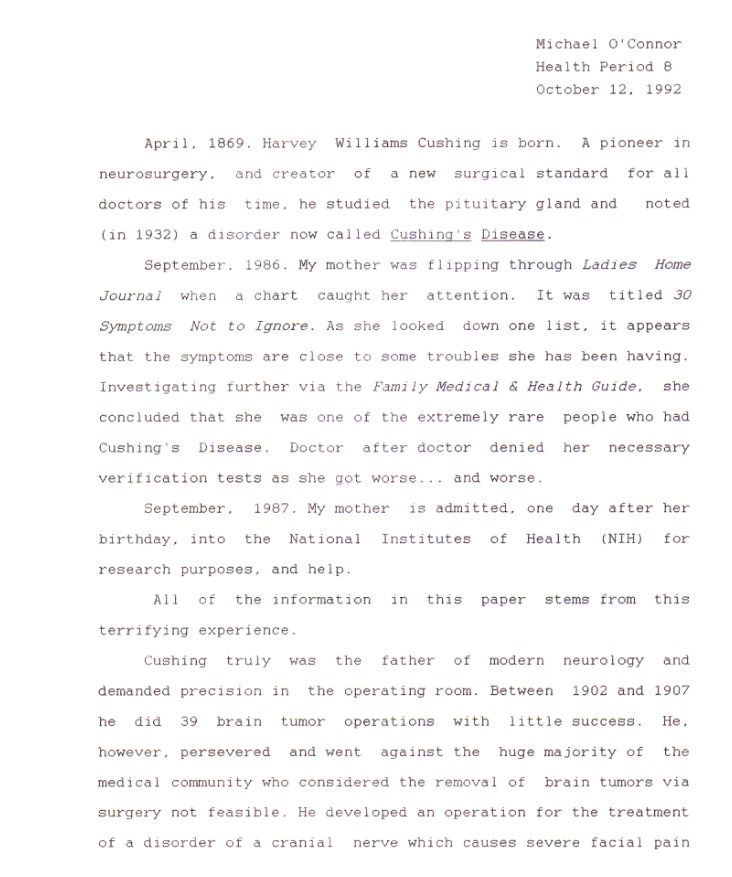
Michael wrote this paper on Cushing’s when he was in the 7th grade. From the quality of the pages, he typed this on typing paper – no computers yet!
Click on each page to enlarge.
When Michael started having headache issues in middle school, I had him tested for Cushing’s. I had no idea yet if it could be familial but I wasn’t taking any chances. It turned out that my father had also had some unnamed endocrine issues. Hmmm…
I survived my time and surgery at NIH and Michael grew up to be a wonderful young man, if an only child. 🙂
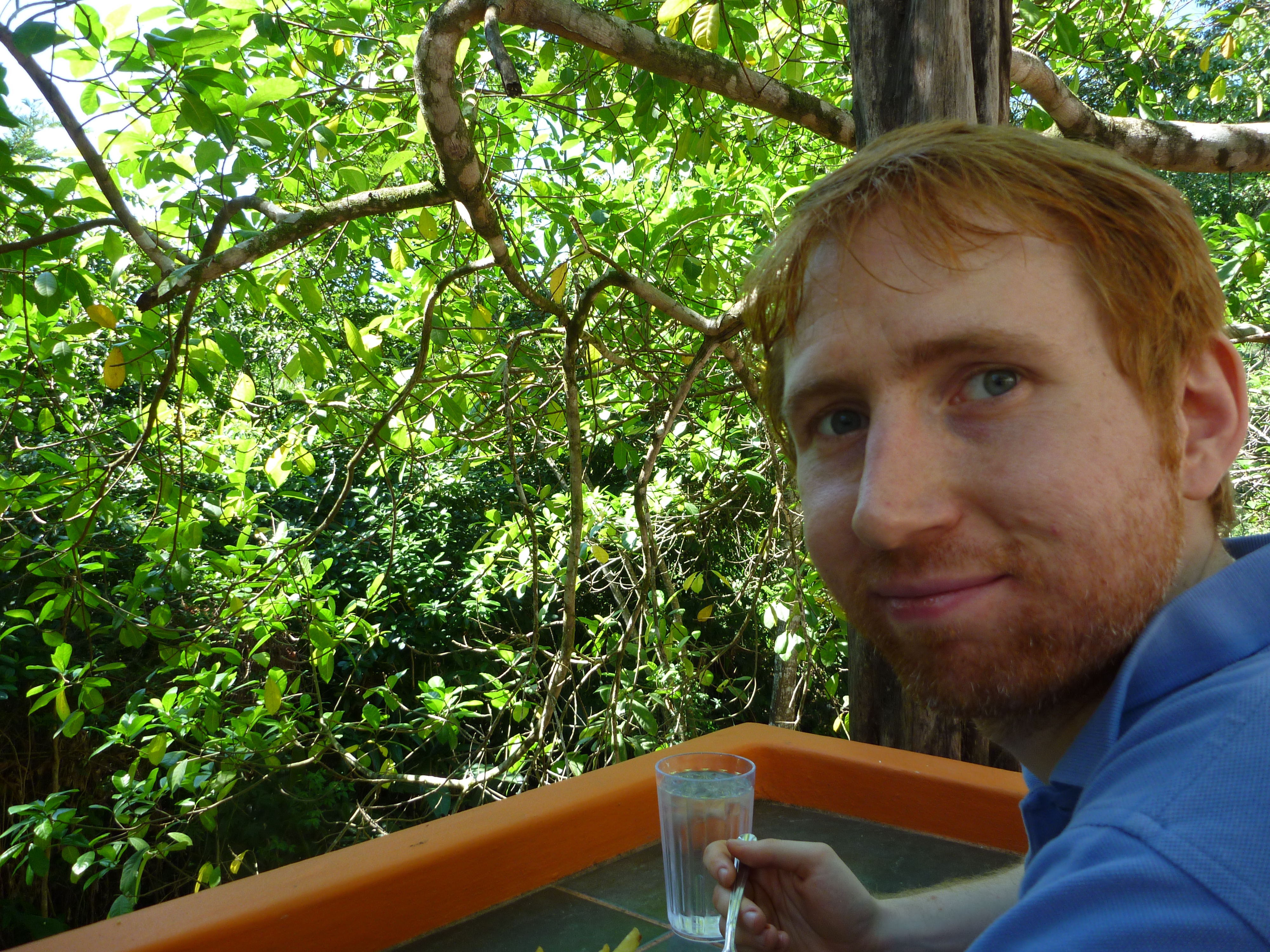
After I survived kidney cancer (Day Twelve, Cushing’s Awareness Challenge 2015) Michael and I went zip-lining – a goal of mine after surviving that surgery. This photo was taken in a treetop restaurant in Belize.
For the mathematically inclined, this is his blog. Xor’s Hammer. I understand none of it. He also has a page of Math and Music, which I also don’t understand.
Myth: After a “cure” for Cushing’s, everyone heals and goes back to normal. All Cushing’s patients can easily heal with no repercussions after Cushing’s. After pituitary surgery or a Bilateral Adrenalectomy (BLA), life is great and being “cured” means having a “normal” life! After all, surgery is a “cure” and about 6 weeks later, you are back to normal. “Say, you had surgery XYZ long ago! Shouldn’t you be better by now?!!!!”
Fact: I can not even tell you how many people asked me “aren’t you better yet?!” after both of my surgeries! There are too many to count! There is a misperception that surgery means a cure and therefore, healing should happen magically and quickly. No! No! No! This is far from the truth.
The sad reality is that even some medical doctors buy into this myth and expect quick healing in their patients. However, they are not living in their patients bodies nor have they obviously read the extensive research on this. Research has shown that the healing process after surgery is a long and extensive one. One endocrinologist, expert from Northwestern, even referred to the first year after pituitary surgery for patients as “the year from hell”! He literally quoted that on a slide presentation.
It takes at least one year after pituitary surgery, for instance, to even manage hormones effectively. Surgery is invasive and hard. However, the hardest part comes AFTER surgery. This is when the body is compensating for all of the years of hormonal dysregulation and the patient is trying to get his/her levels back to normal.
There is a higher rate of recurrence of Cushing’s then we once thought. This means that after a patient has achieved remission from this illness, it is likely to come back. In these cases, a patient faces other treatments that may include radiation, the same type of surgery, or an alternative surgery.
For many pituitary patients who experience multiple recurrences, the last resort is to attack the source by removing both adrenal glands. This procedure is known as a Bilateral Adrenalectomy or BLA. In these cases, it is said that the patient “trades one disease for another”, now becoming adrenally insufficient and having Addison’s Disease. Both Pituitary and Adrenal patients are faced with a lifetime of either Secondary or Primary Adrenal Insufficiency.
Adrenal Insufficiency is also life threatening and adrenal crises can potentially lead to death. Additionally, research says that BLA patients take, on average, 3-5 years for their bodies to readjust and get anywhere near “normal”. Most patients will tell you that they never feel “normal” again!
Think of these facts the next time you feel tempted to ask your friend, family, or loved one, “why is it taking so long to get better after surgery?”. Remember that in addition to the aforementioned points; problems from Cushing’s can linger for years after surgery! One Cushing’s patient stated, “I’m 5 years post-op and I STILL have problems!” This mirrors the sentiments of many of us in the Cushing’s community. Please be conscious of this when supporting your loved one after treatment.
You can find more information in the following links:
Myth: “It is MY fault that I got Cushing’s. I did something wrong that caused me to be sick! If I would have just done XYZ, this would not be happening to me!”
Fact: This is a very controversial topic because we don’t like to talk about it. However, many people struggle with this myth. We NEED to dispel this myth my friends! Patients themselves assume responsibility, accountability, and self blame for becoming ill.
To compound all of that, patients are often told by loved ones, family, and sometimes even their churches or other supports that there is something that THEY could be doing or haven’t done that has caused their declining health. “If you would just follow that raw food diet, then all of your symptoms would go away”, “Juicing is the answer! I told you to juice and you wouldn’t get those tumors!”, Sometimes, you are told that if you would just pray harder or have greater faith, then there is no way that you would be sick right now. And my absolute favorite, “you are just too obsessed with being sick and having Cushing’s! Stop thinking that you have it and it will go away!”.
Now, don’t get me wrong, I find value in “positive thinking” and affirming health, wealth, and all kinds of great things. This helps build up strength and personally keeps me motivated, especially during the times that I feel like absolutely throwing in the towel and giving up!
However, I am NOT the reason and YOU are not the reason for this war with this dreadful disease. What many people don’t understand is how tenacious, brave, courageous, and INDOMITABLE you are! Cushing’s patients do not just get surgery and then everything is magically OK.
Many patients have to go through multiple surgeries, sometimes radiation, sometimes years of testing to find the ultimate source of the disease, even after having several organs messed with. Even after patients obtain their “cure”, they are faced with residual and lingering negative effects of the illness, other hormone dysregulation issues, and the anxiety and fear of a recurrence which is based in absolute reality.
There are people, like myself, who are in remission from Cushing’s, BUT we now have Addison’s Disease/Adrenal Insufficiency as a result of removing vital organs in order to save our lives from Cushing’s. So, are we to think that Adrenal Insufficiency is ALSO our faults every time we near death after an adrenal crisis?! NO! NO! NO!
This is NOT your fault! This is NOT your doing! STOP blaming yourself! The best you can do is to FIGHT! Take an empowered stance by saying “NO” to those who won’t listen. Say “NO” to those who project blame onto you and tell you that this is just a “fat person’s excuse to stay fat”. You are not just a “fat person”! YOU are an amazing person who is fighting for your life!
Let me be clear that this blaming is common and we all do it. In my “5 stages of Loss” series on Youtube; I address the “Bargaining” stage of loss, in which we assume responsibility for getting sick or even for getting better.
Everyone should watch this to understand why and how we do this:
Remember, you are a survivor! YOU are Indomitable!!! This is NOT your fault! You WILL overcome!
It’s Sunday again, so this is another semi-religious post so feel free to skip it 🙂
I’m sure that many would think that Abide With Me is a pretty strange choice for my all-time favorite hymn, especially since it often shows up at funerals and memorial services.
My dad was a Congregational (now United Church of Christ) minister so I was pretty regular in church attendance in my younger years.
Some Sunday evenings, he would preach on a circuit and I’d go with him to some of these tiny churches. The people there, mostly older folks, liked the old hymns best – Fanny Crosby and so on.
So, some of my “favorite hymns” are those that I sang when I was out with my Dad. Fond memories from long ago.
In 1986 I was finally diagnosed with Cushing’s after struggling with doctors and trying to get them to test for about 5 years. I was going to go into the NIH (National Institutes of Health) in Bethesda, MD for final testing and then-experimental pituitary surgery.
I was terrified and sure that I wouldn’t survive the surgery.
Somehow, I found a 3-cassette tape set of Reader’s Digest Hymns and Songs of Inspiration and ordered that. The set came just before I went to NIH and I had it with me.
At NIH I set up a daily “routine” of sorts and listening to these tapes was a very important part of my day and helped me get through the ordeal of more testing, surgery, post-op and more.
When I had my kidney cancer surgery, those tapes were long broken and irreplaceable, but I had replaced all the songs – this time on my iPod.
Abide With Me was on this original tape set and it remains a favorite to this day. Whenever we have an opportunity in church to pick a favorite, my hand always shoots up and I request page 700. When someone in one of my handbell groups moves away, we always sign a hymnbook and give it to them. I sign page 700.
I think that many people would probably think that this hymn is depressing. Maybe it is but to me it signifies times in my life when I thought I might die and I was so comforted by the sentiments here.
This hymn is often associated with funeral services and has given hope and comfort to so many over the years – me included.
If you abide in Me, and My words abide in you, you will ask what you desire, and it shall be done for you.
~John 15:7
Abide With Me
Words: Henry F. Lyte, 1847.
Music: Eventide, William H. Monk, 1861. Mrs. Monk described the setting:
This tune was written at a time of great sorrow—when together we watched, as we did daily, the glories of the setting sun. As the last golden ray faded, he took some paper and penciled that tune which has gone all over the earth.
Lyte was inspired to write this hymn as he was dying of tuberculosis; he finished it the Sunday he gave his farewell sermon in the parish he served so many years. The next day, he left for Italy to regain his health. He didn’t make it, though—he died in Nice, France, three weeks after writing these words. Here is an excerpt from his farewell sermon:
O brethren, I stand here among you today, as alive from the dead, if I may hope to impress it upon you, and induce you to prepare for that solemn hour which must come to all, by a timely acquaintance with the death of Christ.
For over a century, the bells of his church at All Saints in Lower Brixham, Devonshire, have rung out “Abide with Me” daily. The hymn was sung at the wedding of King George VI, at the wedding of his daughter, the future Queen Elizabeth II, and at the funeral of Nobel peace prize winner Mother Teresa of Calcutta in1997.
Abide with me; fast falls the eventide;
The darkness deepens; Lord with me abide.
When other helpers fail and comforts flee,
Help of the helpless, O abide with me.
Swift to its close ebbs out life’s little day;
Earth’s joys grow dim; its glories pass away;
Change and decay in all around I see;
O Thou who changest not, abide with me.
Not a brief glance I beg, a passing word;
But as Thou dwell’st with Thy disciples, Lord,
Familiar, condescending, patient, free.
Come not to sojourn, but abide with me.
Come not in terrors, as the King of kings,
But kind and good, with healing in Thy wings,
Tears for all woes, a heart for every plea—
Come, Friend of sinners, and thus bide with me.
Thou on my head in early youth didst smile;
And, though rebellious and perverse meanwhile,
Thou hast not left me, oft as I left Thee,
On to the close, O Lord, abide with me.
I need Thy presence every passing hour.
What but Thy grace can foil the tempter’s power?
Who, like Thyself, my guide and stay can be?
Through cloud and sunshine, Lord, abide with me.
I fear no foe, with Thee at hand to bless;
Ills have no weight, and tears no bitterness.
Where is death’s sting? Where, grave, thy victory?
I triumph still, if Thou abide with me.
Hold Thou Thy cross before my closing eyes;
Shine through the gloom and point me to the skies.
Heaven’s morning breaks, and earth’s vain shadows flee;
Fact: In the words of our dear friend and advocate, Robin Ess, “There are many genetic varieties with quite a few discovered in the past couple of years. Plus, there are several types such as adrenal, ectopic, and pituitary. And so on”….Amazingly, some doctors do not realize that there are different varieties of Cushing’s and that the symptoms can come from a different source.
For instance, a doctor might rule out a pituitary tumor and completely dismiss the patient, even with biochemical evidence of Cushing’s. That doctor, instead of dismissing the patient, should thoroughly look for other potential sources, such as an adrenal tumor, or yet another source. Did you know that tumors on one’s lungs can even cause Cushing’s? Most people don’t know that.
MaryONote: Folks might be interested in listening to this podcast episode with Jayne, a Cushing’s patient who had pituitary surgeries and a bilateral adrenalectomy before finding the true source of her ectopic Cushing’s – lung tumors.
Myth: Cushing’s Syndrome/Disease can be healed or cured through change in diet or exercise.
Fact: NO! Caloric intake or lack of exercise has NO impact on weight gain and/ or loss in persons with Cushing’s.
Saying that someone “cheated” on their diet may seem reasonable to some as a reason for weight gain but I assure you that a candy bar or a piece of pie does not make a person with Cushing’s gain weight or get sick. Excess cortisol is the reason for Cushing’s symptoms. Treating the disease is the only way to alleviate symptoms.
The first line of treatment with the highest rate of remission is currently surgery to remove the tumor (s) from the pituitary, adrenal gland, or ectopic source.
Dr. Cushing was born in Cleveland Ohio. The fourth generation in his family to become a physician, he showed great promise at Harvard Medical School and in his residency at Johns Hopkins Hospital (1896 to 1900), where he learned cerebral surgery under William S. Halsted
After studying a year in Europe, he introduced the blood pressure sphygmomanometer to the U.S.A. He began a surgical practice in Baltimore while teaching at Johns Hopkins Hospital (1901 to 1911), and gained a national reputation for operations such as the removal of brain tumors. From 1912 until 1932 he was a professor of surgery at Harvard Medical School and surgeon in chief at Peter Bent Brigham Hospital in Boston, with time off during World War I to perform surgery for the U.S. forces in France; out of this experience came his major paper on wartime brain injuries (1918). In addition to his pioneering work in performing and teaching brain surgery, he was the reigning expert on the pituitary gland since his 1912 publication on the subject; later he discovered the condition of the pituitary now known as “Cushing’s disease“.
Today, April 8th, is Cushing’s Awareness Day. Please wear your Cushing’s ribbons, t-shirts, awareness bracelets or Cushing’s colors (blue and yellow) and hand out Robin’s wonderful Awareness Cards to get a discussion going with anyone who will listen.
And don’t just raise awareness on April 8. Any day is a good day to raise awareness.
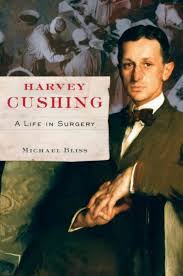
I found Dr. Cushing’s life to be most interesting. I had previously known of him mainly because his name is associated with a disease I had – Cushing’s. This book doesn’t talk nearly enough about how he came to discover the causes of Cushing’s disease, but I found it to be a valuable resource, anyway.
I was so surprised to learn of all the “firsts” Dr. Cushing brought to medicine and the improvements that came about because of him. Dr. Cushing introduced the blood pressure sphygmomanometer to America, and was a pioneer in the use of X-rays.
He even won a Pulitzer Prize. Not for medicine, but for writing the biography of another Doctor (Sir William Osler).
Before his day, nearly all brain tumor patients died. He was able to get the number down to only 5%, unheard of in the early 1900s.
This is a very good book to read if you want to learn more about this most interesting, influential and innovative brain surgeon.
What Would Harvey Say?
More than 80 years ago renowned neurosurgeon, Dr. Harvey Cushing, discovered a tumor on the pituitary gland as the cause of a serious, hormone disorder that leads to dramatic physical changes in the body in addition to life-threatening health concerns. The discovery was so profound it came to be known as Cushing’s disease. While much has been learned about Cushing’s disease since the 1930s, awareness of this rare pituitary condition is still low and people often struggle for years before finding the right diagnosis.
Read on to meet the man behind the discovery and get his perspective on the present state of Cushing’s disease.
* What would Harvey Cushing say about the time it takes for people with Cushing’s disease to receive an accurate diagnosis?
Cushing’s disease still takes too long to diagnose!
Despite advances in modern technology, the time to diagnosis for a person with Cushing’s disease is on average six years. This is partly due to the fact that symptoms, which may include facial rounding, thin skin and easy bruising, excess body and facial hair and central obesity, can be easily mistaken for other conditions. Further awareness of the disease is needed as early diagnosis has the potential to lead to a more favorable outcome for people with the condition.
* What would Harvey Cushing say about the advances made in how the disease is diagnosed?
Significant progress has been made as several options are now available for physicians to use in diagnosing Cushing’s disease.
In addition to routine blood work and urine testing, health care professionals are now also able to test for biochemical markers – molecules that are found in certain parts of the body including blood and urine and can help to identify the presence of a disease or condition.
* What would Harvey Cushing say about disease management for those with Cushing’s disease today?
Patients now have choices but more research is still needed.
There are a variety of disease management options for those living with Cushing’s disease today. The first line and most common management approach for Cushing’s disease is the surgical removal of the tumor. However, there are other management options, such as medication and radiation that may be considered for patients when surgery is not appropriate or effective.
* What would Harvey Cushing say about the importance of ongoing monitoring in patients with Cushing’s disease?
Routine check-ups and ongoing monitoring are key to successfully managing Cushing’s disease.
The same tests used in diagnosing Cushing’s disease, along with imaging tests and clinical suspicion, are used to assess patients’ hormone levels and monitor for signs and symptoms of a relapse. Unfortunately, more than a third of patients experience a relapse in the condition so even patients who have been surgically treated require careful long-term follow up.
* What would Harvey Cushing say about Cushing’s disease patient care?
Cushing’s disease is complex and the best approach for patients is a multidisciplinary team of health care professionals working together guiding patient care.
Whereas years ago patients may have only worked with a neurosurgeon, today patients are typically treated by a variety of health care professionals including endocrinologists, neurologists, radiologists, mental health professionals and nurses. We are much more aware of the psychosocial impact of Cushing’s disease and patients now have access to mental health professionals, literature, patient advocacy groups and support groups to help them manage the emotional aspects of the disease.
Way back when we first got married, my husband thought we might have a big family with a lot of kids. He was from a family of 6 siblings, so that’s what he was accustomed to. I am an only child so I wasn’t sure about having so many.
I needn’t have worried.
In January, 1974 I had a miscarriage. I was devastated. My father revealed that my mother had also had a miscarriage. I had no idea.
At some point after this I tried fertility drugs. Clomid and another drug. One or both drugs made me very angry/depressed/bitchy (one dwarf I left off the image) Little did I know that these meds were a waste of time.
Eventually, I did get pregnant and our wonderful son, Michael was born. It wasn’t until he was seven that I was finally, actually diagnosed with Cushing’s.
When I had my early Cushing’s symptoms, I thought I was pregnant again but it was not to be.
I’ll never forget the autumn when he was in second grade. He was leaving for school and I said goodbye to him. I knew I was going into NIH that day for at least 6 weeks and my future was very iffy. The night before, I had signed my will – just in case. He just turned and headed off with his friends…and I felt a little betrayed.
Michael wrote this paper on Cushing’s when he was in the 7th grade. From the quality of the pages, he typed this on typing paper – no computers yet!
Click on each page to enlarge.
When Michael started having headache issues in middle school, I had him tested for Cushing’s. I had no idea yet if it could be familial but I wasn’t taking any chances. It turned out that my father had also had some unnamed endocrine issues. Hmmm…
I survived my time and surgery at NIH and Michael grew up to be a wonderful young man, if an only child. 🙂
After I survived kidney cancer (Day Twelve, Cushing’s Awareness Challenge 2015) Michael and I went zip-lining – a goal of mine after surviving that surgery. This photo was taken in a treetop restaurant in Belize.
For the mathematically inclined, this is his blog. Xor’s Hammer. I understand none of it. He also has a page of Math and Music, which I also don’t understand.
The above is the official Cushing’s path to a diagnosis but here’s how it seems to be in real life:
Egads! I remember the naive, simple days when I thought I’d give them a tube or two of blood and they’d tell me I had Cushing’s for sure.
Who knew that diagnosing Cushing’s would be years of testing, weeks of collecting every drop of urine, countless blood tests, many CT and MRI scans…
Then going to NIH, repeating all the above over 6 weeks inpatient plus an IPSS test, an apheresis (this was experimental at NIH) and speciality blood tests…
The path to a Cushing’s diagnosis is a long and arduous one but you have to stick with it if you believe you have this Syndrome.