🦓 Day 14, Cushing’s Awareness Challenge

Way back when we first got married, my husband thought we might have a big family with a lot of kids.  He was from a family of 6 siblings, so that’s what he was accustomed to.  I am an only child so I wasn’t sure about having so many.

I needn’t have worried.

In January 1974 I had a miscarriage.  I was devastated. My father revealed that my mother had also had a miscarriage.  I had no idea.

At some point later I tried fertility drugs.  Clomid and another drug.  One or both drugs made me very angry/depressed/bitchy (one dwarf I left off the image)  Little did I know that these meds were a waste of time.

Eventually,  I did get pregnant and our wonderful son, Michael was born.  It wasn’t until he was seven that I was finally, actually diagnosed with Cushing’s.

When I had my early Cushing’s symptoms, I thought I was pregnant again but it was not to be.

I’ll never forget the fall when he was in second grade.  He was leaving for school and I said goodbye to him.  I knew I was going into NIH that day for at least 6 weeks and my future was very iffy.  The night before, I had signed my will – just in case.  He just turned and headed off with his friends…and I felt a little betrayed.

Michael wrote this paper on Cushing’s when he was in the 7th grade. From the quality of the pages, he typed this on typing paper – no computers yet!

Click on each page to enlarge.
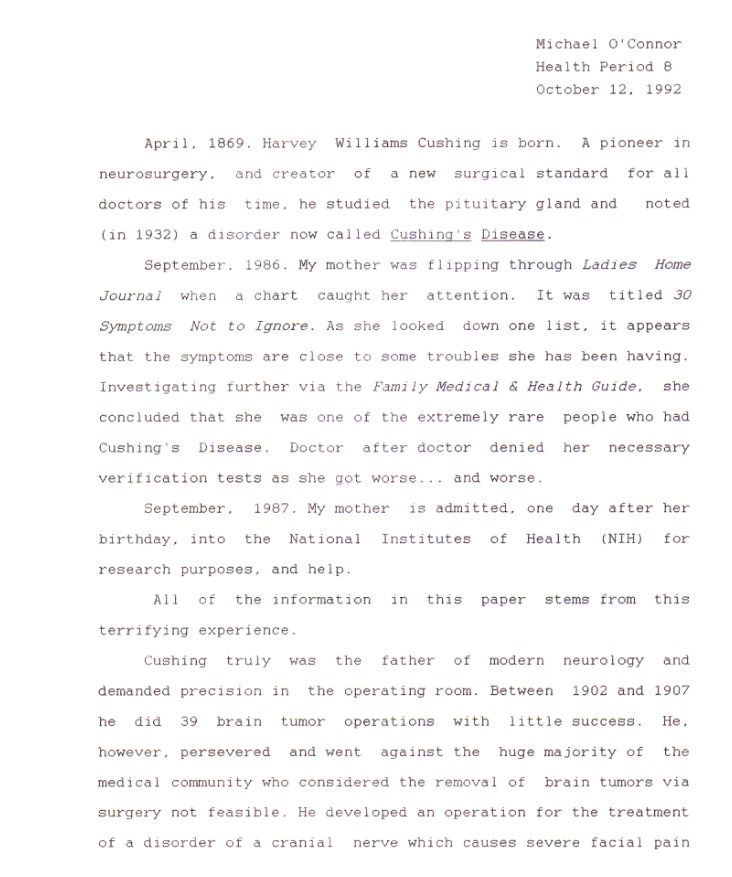
When Michael started having headache issues in middle school, I had him tested for Cushing’s.  I had no idea yet if it could be familial but I wasn’t taking any chances.  It turned out that my father had also had some unnamed endocrine issues.  Hmmm…

I survived my time and surgery at NIH and Michael grew up to be a wonderful young man, if an only child.  🙂
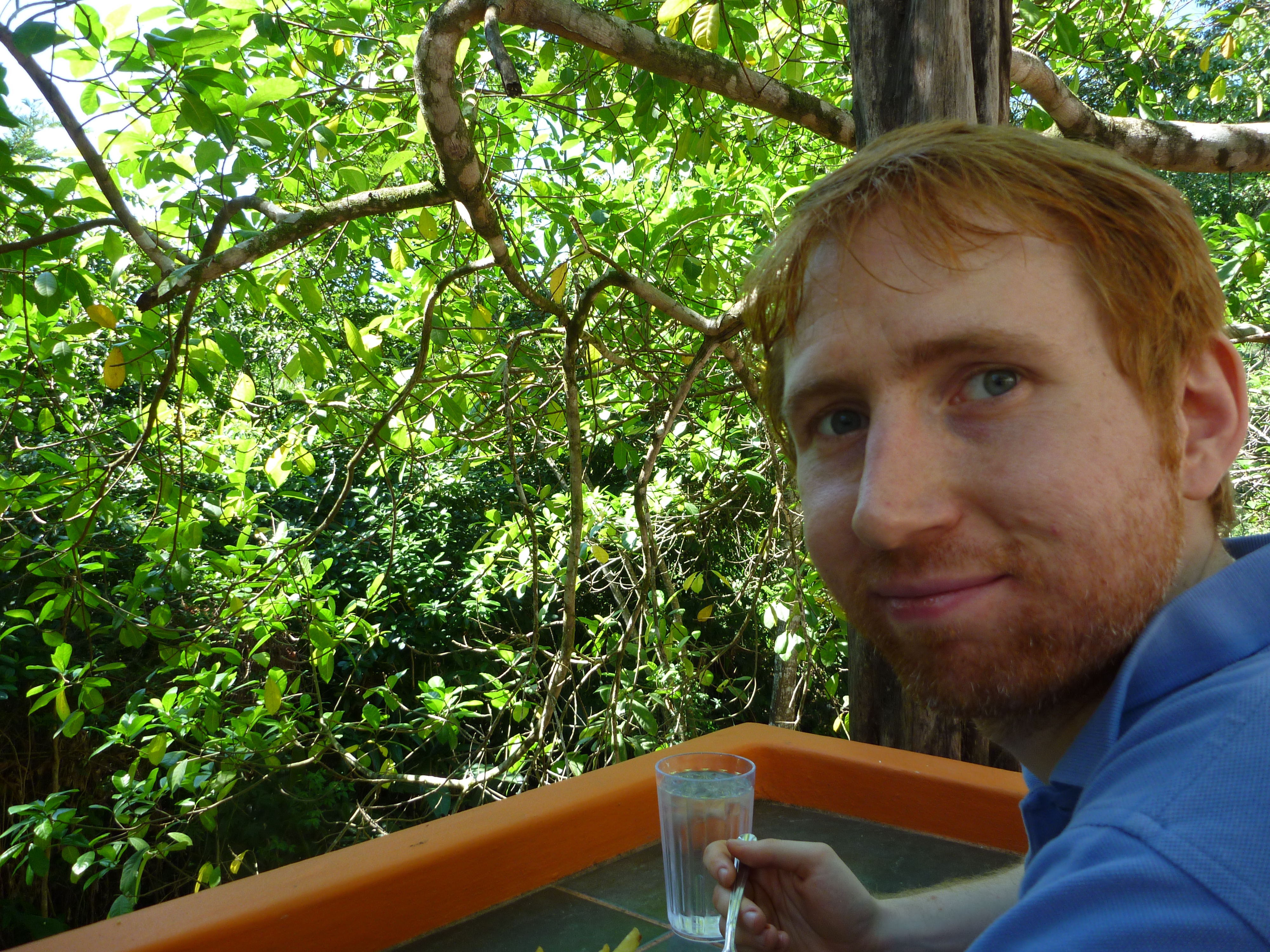
After I survived kidney cancer (Day Twelve, Cushing’s Awareness Challenge 2015) Michael and I went zip-lining – a goal of mine after surviving that surgery.  This photo was taken in a treetop restaurant in Belize.

For the mathematically inclined, this is his blog.  Xor’s Hammer.  I understand none of it.  He also has a page of Math and Music, which I also don’t understand.

I know it doesn’t fit into a Cushing’s awareness post but just because I’m a very proud mama – Michael got a PhD in math from Cornell and his thesis was Using Tree Automata to Investigate Intuitionistic Propositional Logic

Michael explains How do we know the quintic is unsolvable?

And, from his wedding:

proud-mom

And, as of March 7, 2021:

And then there were two 🙂

Myth: After a “cure” for Cushing’s, everyone heals and goes back to normal.

Myth: After a “cure” for Cushing’s, everyone heals and goes back to normal. All Cushing’s patients can easily heal with no repercussions after Cushing’s. After pituitary surgery or a Bilateral Adrenalectomy (BLA), life is great and being “cured” means having a “normal” life! After all, surgery is a “cure” and about 6 weeks later, you are back to normal. “Say, you had surgery XYZ long ago! Shouldn’t you be better by now?!!!!”

myth-busted

Fact: I can not even tell you how many people asked me “aren’t you better yet?!” after both of my surgeries! There are too many to count! There is a misperception that surgery means a cure and therefore, healing should happen magically and quickly. No! No! No! This is far from the truth.

The sad reality is that even some medical doctors buy into this myth and expect quick healing in their patients. However, they are not living in their patients bodies nor have they obviously read the extensive research on this. Research has shown that the healing process after surgery is a long and extensive one. One endocrinologist, expert from Northwestern, even referred to the first year after pituitary surgery for patients as “the year from hell”! He literally quoted that on a slide presentation.

It takes at least one year after pituitary surgery, for instance, to even manage hormones effectively. Surgery is invasive and hard. However, the hardest part comes AFTER surgery. This is when the body is compensating for all of the years of hormonal dysregulation and the patient is trying to get his/her levels back to normal.

There is a higher rate of recurrence of Cushing’s then we once thought. This means that after a patient has achieved remission from this illness, it is likely to come back. In these cases, a patient faces other treatments that may include radiation, the same type of surgery, or an alternative surgery.

For many pituitary patients who experience multiple recurrences, the last resort is to attack the source by removing both adrenal glands. This procedure is known as a Bilateral Adrenalectomy or BLA. In these cases, it is said that the patient “trades one disease for another”, now becoming adrenally insufficient and having Addison’s Disease. Both Pituitary and Adrenal patients are faced with a lifetime of either Secondary or Primary Adrenal Insufficiency.

Adrenal Insufficiency is also life threatening and adrenal crises can potentially lead to death. Additionally, research says that BLA patients take, on average, 3-5 years for their bodies to readjust and get anywhere near “normal”. Most patients will tell you that they never feel “normal” again!

Think of these facts the next time you feel tempted to ask your friend, family, or loved one, “why is it taking so long to get better after surgery?”. Remember that in addition to the aforementioned points; problems from Cushing’s can linger for years after surgery! One Cushing’s patient stated, “I’m 5 years post-op and I STILL have problems!” This mirrors the sentiments of many of us in the Cushing’s community. Please be conscious of this when supporting your loved one after treatment.

You can find more information in the following links:

http://onlinelibrary.wiley.com/doi/10.1111/j.1365-2265.2011.04124.x/abstract;jsessionid=CC58CF32990A60593028F4173902EC47.f03t03?deniedAccessCustomisedMessage&userIsAuthenticated=false

http://press.endocrine.org/doi/abs/10.1210/jc.2013-1470

http://press.endocrine.org/doi/abs/10.1210/jc.2012-2893


Written by Dr. Karen Thames of  Empowering People with Invisible Chronic Illness – The EPIC Foundation